

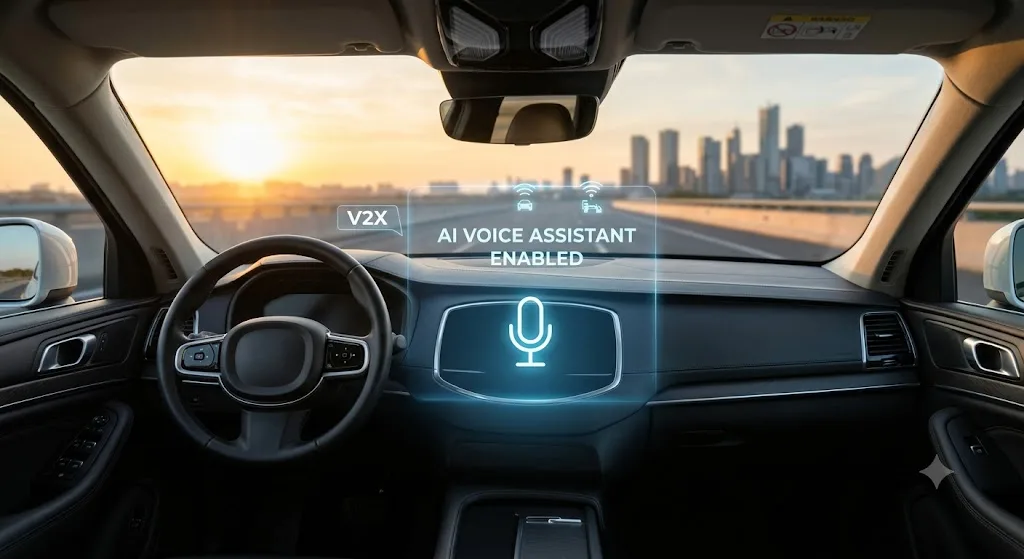
For most of automotive history, the most important voice inside a car belonged to the person in the passenger seat.
It warned you about a missed turn, suggested somewhere to eat and occasionally questioned your choice of shortcut. When nobody was sitting beside you, the radio filled the silence.
That arrangement is beginning to change.
The next generation of in-car artificial intelligence will do more than play a requested song or calculate the fastest route. It will hold conversations, remember preferences, explain warning lights, recommend places along a journey and potentially connect drivers with dealerships, repair shops and tire service providers.
In other words, the dashboard voice is evolving from a command-operated tool into something closer to a digital passenger.
The End of Robotic Voice Commands
Traditional automotive voice assistants have never been particularly good conversationalists.
Drivers learned to speak in carefully constructed commands:
“Call John.”
“Navigate home.”
“Play classic rock.”
When the assistant misunderstood a word, the entire request often had to be repeated from the beginning. It was technically voice-controlled, but it rarely felt natural.
Generative AI changes that interaction.
In April 2026, Google announced that Gemini was beginning to replace Google Assistant in vehicles equipped with Google built-in. The upgrade is being distributed not only to new models but also to some existing vehicles through software updates.
Instead of memorizing the correct command, drivers can speak normally. They can ask for a highly rated restaurant along the route, add that they want outdoor seating and then follow up by asking about parking. Gemini can also draw on manufacturer-provided owner’s manuals to answer questions about specific vehicle features.
Mercedes-Benz had already demonstrated where this was heading. Its integration of Google Cloud’s Automotive AI Agent was designed to support multi-stage conversations and remember enough context for a driver to pause and later continue the same discussion.
This may sound like a modest improvement, but it represents a fundamental change. The driver no longer has to adapt to the software. The software is beginning to adapt to the driver.
A Voice That Knows the Vehicle
The most useful in-car companion will not simply be a general chatbot running through the speakers.
It will understand the car.
Imagine asking:
“Why did that tire-pressure warning appear after the temperature dropped?”
“Can I safely continue driving with this warning light?”
“When did I last rotate the tires?”
“Find a tire dealer near my route that is still open.”
“Book a service appointment for Tuesday, but avoid the time of my morning meeting.”
A connected AI could combine the owner’s manual, real-time vehicle data, maintenance history, location and calendar information to produce a genuinely useful answer.
For automotive retailers, this creates an opportunity to replace generic reminders with contextual conversations. A static notification saying “Service due” is easy to ignore. A voice explaining that the front tires are wearing faster than the rear tires, followed by an offer to schedule a rotation, is much harder to dismiss.
The same system could explain the difference between repairing and replacing a tire, check whether a product is in stock and send the appointment details to the driver’s phone.
That would make the assistant more than a cabin feature. It would become a bridge between the vehicle and the entire automotive service ecosystem.
Drivers Already Accept Third-Party Connections
Connected-car adoption remains uneven, but drivers are not rejecting connectivity itself.
Smartcar’s 2025 survey of more than 1,000 drivers in the United States and Europe found that 56% had connected their vehicle to a third-party automotive application. At the same time, 76% said they were not subscribed to their automaker’s connected-services package.
Among drivers who did subscribe, however, 67% said they would pay more to gain additional features.
The message for automakers is fairly clear: consumers are willing to connect their cars and may even pay for the privilege, but only when the service offers obvious value.
A companion that merely tells jokes and changes the cabin temperature will struggle to justify another monthly fee. One that reduces everyday friction could be different.
The strongest services may combine practical assistance with personality. The AI could manage navigation and maintenance while also learning whether the driver prefers brief answers, detailed explanations or a more conversational tone.
What Companion Platforms Can Teach Automakers
Automotive companies have traditionally approached assistants as functional interfaces. Companion platforms approach them as personalities.
That difference matters.
An AI companion website such as https://joi.com/ allows users to interact with customizable digital characters through conversations and generated visual content. The automotive lesson is not that every companion-platform feature belongs behind the wheel—visual, intimate or highly absorbing content clearly does not.
The lesson is that people respond to continuity, personality and choice.
Users do not necessarily want the same neutral corporate voice in every vehicle. One driver may prefer a calm and concise assistant. Another may enjoy a warmer personality during a long commute. A family might want a child-friendly travel storyteller, while a professional driver could select a direct assistant focused on route efficiency and vehicle status.
Companion platforms also demonstrate the importance of memory. A system becomes more useful when it remembers that the driver dislikes toll roads, normally stops after two hours, prefers independent coffee shops and wants tire pressures displayed in PSI rather than bar.
Without memory, every conversation is a first meeting. With memory, the assistant begins to feel like part of the vehicle.
Joi’s current platform emphasizes customizable characters and interactions across chat, photos and video, illustrating how quickly AI products are moving beyond plain text boxes.
The Best AI May Know When to Stop Talking
A more engaging assistant is not automatically a safer assistant.
In 2024, distracted-driver crashes killed 3,208 people and injured more than 315,000 in the United States, according to the National Highway Traffic Safety Administration.
Voice interaction can reduce the need to look at a screen, but it does not eliminate cognitive distraction. A driver can have both hands on the wheel and both eyes on the road while paying too little attention to traffic.
Recent research illustrates the challenge.
A 2026 on-road study involving 32 licensed drivers found that interactions with an advanced large-language-model assistant produced cognitive demands broadly comparable to hands-free telephone conversations. The voice-based system had low visual demand, but it still required mental attention.
Another study, conducted with 30 participants in a driving simulator, found that an informal assistant could be more distracting than a formal one, particularly when it discussed personal subjects.
These findings suggest that automotive AI needs a different personality while the vehicle is moving.
During straightforward highway driving, the assistant might provide conversation, travel information or simple planning help. In heavy traffic, bad weather or a complicated intersection, it should shorten its answers, postpone nonessential topics and avoid emotionally demanding discussions.
The smartest digital passenger will be the one that recognizes when the human driver needs silence.
Privacy Cannot Be Hidden in the Glovebox
A personalized companion requires data.
It may know where the vehicle travels, when the driver leaves home, which businesses they visit, who they call and what they discuss during a journey. If connected to vehicle diagnostics, it may also know how fast they drive, how sharply they brake and when they ignore a mechanical warning.
That makes privacy central to the product rather than a legal detail.
S&P Global Mobility reported in 2025 that data privacy remained the connected-car industry’s biggest consumer concern. Its research also found that the proportion of respondents willing to pay for connected services fell from 86% in 2024 to 68% in 2025. Cost, subscription fatigue and concerns about how data is collected all contributed to resistance.
The Car Connectivity Consortium reached a similar conclusion. In a 2025 survey of more than 250 automotive and technology professionals across over 20 countries, 60% identified security and ease of use as leading priorities for connected vehicles.
Drivers should therefore be able to see what an assistant remembers, delete sensitive conversations and disable categories of data collection. There also needs to be a clear distinction between information processed inside the vehicle and information sent to cloud services.
Trust will be especially important when assistants begin recommending products or service providers. A driver should know whether a tire shop is being suggested because it is nearby and highly rated—or because the company paid for preferred placement.
A New Role for Dealers and Tire Retailers
For dealerships and automotive-service businesses, in-car AI could create a direct but less intrusive customer channel.
The assistant might:
- explain a tire-pressure or tread-depth alert;
- identify the correct replacement tire;
- compare available appointment times;
- check current stock at a nearby location;
- describe the difference between tire options;
- remind the driver about seasonal tire changes;
- request roadside assistance after a puncture;
- follow up after a completed repair.
The critical difference is timing.
Traditional marketing sends messages when the business wants attention. Context-aware AI can offer help when the driver actually needs it.
That could improve conversion rates without making the vehicle feel like a rolling advertisement. But restraint will matter. Nobody wants their car interrupting a quiet drive to announce a weekend discount on brake pads.
Successful automotive AI will prioritize assistance and allow commerce to follow naturally.
Radio Is Not Really Going Anywhere
Despite the headline, radio will survive.
Music, podcasts and live broadcasting remain ideal companions because they can entertain without demanding a response. What may disappear is the radio’s position as the primary interface for the cabin.
Drivers will increasingly ask an AI to build the soundtrack, summarize a news program, explain something mentioned in a podcast or find a local station covering a weather emergency.
The assistant becomes the layer through which other audio is discovered and controlled.
Today, drivers enter a car and choose what they want to hear. Tomorrow, the car may already understand the mood, the route and the purpose of the journey.
The most important voice in the vehicle will not necessarily belong to the loudest entertainment service. It will belong to the system that understands when to speak, what information matters and when the driver should simply be left alone with the road.


