

Market Summary
According to Research intelo, the Global Rubber Tyred Gantry Telemetry market size was valued at $1.2 billion in 2024 and is projected to reach $2.85 billion by 2033, expanding at a CAGR of 10.2% during the forecast period of 2025–2033. The primary growth driver for this market is the accelerating adoption of automation and digitalization in port operations, which is facilitating real-time data collection, predictive maintenance, and performance analytics for rubber tyred gantry (RTG) cranes. As global trade volumes surge and logistics operations become increasingly complex, port operators and logistics companies are investing heavily in telemetry solutions to optimize asset utilization, enhance operational efficiency, and reduce downtime, thereby propelling the robust growth of the rubber tyred gantry telemetry market.
Introduction
The Rubber Tyred Gantry Telemetry Market is emerging at the intersection of container-terminal automation, industrial IoT, predictive maintenance, and real-time equipment intelligence. Rubber Tyred Gantry (RTG) cranes are essential for moving and stacking containers across ports, inland terminals, and intermodal yards. As these facilities pursue higher productivity and lower downtime, simply operating an RTG crane efficiently is no longer enough—the equipment must also generate
actionable data.
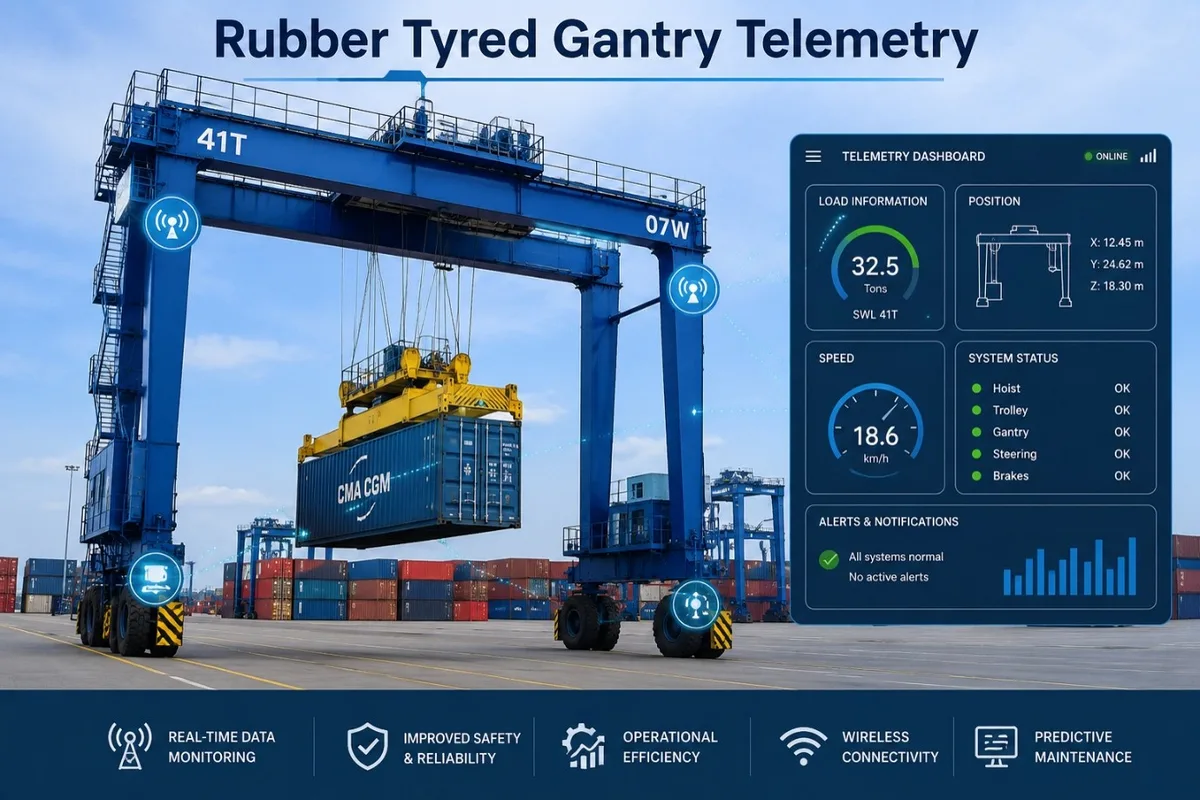
Telemetry provides that missing layer of intelligence. Modern systems can collect information from crane PLCs, CAN buses, sensors, drives, and other equipment systems and convert it into usable operational data. Some commercial telemetry solutions already expose information such as spreader load, hoist, gantry and trolley speeds, fuel consumption, and container moves per hour.
The result is a transition from “Where is my crane?” to “What is my crane telling me?”
What Is the Rubber Tyred Gantry Telemetry Market?
The Rubber Tyred Gantry Telemetry Market refers to the ecosystem of hardware, software, communication infrastructure, sensors, analytics platforms, and services used to collect, transmit, analyze, and visualize operational information from RTG cranes.
An RTG telemetry architecture can connect sensors and existing crane control systems to an edge gateway. The gateway processes or transmits information to a centralized dashboard, cloud platform, terminal operating system, maintenance platform, or analytics engine.
In practical terms, telemetry creates a continuous digital information stream from physical crane activity.
This can help terminal operators understand equipment utilization, container-handling performance, energy consumption, abnormal operating conditions, maintenance requirements, and productivity patterns without depending entirely on manual inspections or operator reports.
Why Is RTG Telemetry Becoming Important?
The Container Yard Is Becoming a Data Environment
Modern container terminals are increasingly managed as interconnected operational ecosystems. RTGs interact with terminal operating systems, trucks, automated equipment, positioning technologies, remote-control systems, maintenance platforms, and yard-management applications.
That makes equipment data increasingly valuable.
A crane that moves containers is generating information every second: load, position, movement, speed, energy consumption, operating cycles, alarms, temperatures, and equipment states. Telemetry captures this information and converts it into a resource that managers can analyze.
Commercial RTG monitoring solutions demonstrate this evolution by connecting directly to equipment control systems and presenting live fleet information for planners and maintenance teams.
Key Components of RTG Telemetry
Sensors and Data Acquisition
Sensors form the physical foundation of telemetry. Depending on the crane architecture, systems can monitor variables such as load, speed, temperature, vibration, pressure, position, electrical characteristics, and equipment status.
The importance of sensors extends beyond collecting numbers. A temperature increase in a motor, unusual vibration in a gearbox, or abnormal movement pattern may provide an early indication of equipment deterioration.
Industrial monitoring providers already use advanced sensors to obtain real-time information about RTG load, position, and equipment conditions.
PLC and CAN Bus Connectivity
Modern telemetry does not necessarily require operators to replace the entire crane control architecture.
Telemetry platforms can connect with existing PLCs and communication systems, allowing operators to extract valuable data from equipment already deployed in the yard. One example of commercial RTG telemetry technology uses J1939 CAN bus and PLC connections to turn crane information into a live data stream.
This compatibility is strategically important because terminals often operate fleets containing cranes of different ages, manufacturers, and technology generations.
Edge Computing
Edge gateways provide an important bridge between the crane and centralized software.
Instead of transmitting every raw sensor value directly to the cloud, edge systems can preprocess information close to the equipment. This can reduce communication requirements, improve response times, and allow selected functions to continue operating even when connectivity is imperfect.
For mobile RTGs moving throughout large yards, this architecture can be particularly valuable.
Connectivity
RTG telemetry may use industrial wireless networks, Wi-Fi, cellular connectivity, private networks, or other communication architectures depending on terminal requirements.
Connectivity is not a minor technical consideration. RTGs move across large areas containing metal containers and heavy equipment, creating challenging radio environments. Wireless monitoring applications therefore need carefully designed coverage and communication reliability.
What Data Does RTG Telemetry Collect?
One of the most interesting aspects of the market is the diversity of information available from an RTG.
Operational Data
Operational telemetry can include crane movement, hoisting activity, trolley movement, gantry speed, container handling cycles, and equipment utilization.
Load Data
Load-related information helps operators understand lifting behavior and workload distribution across a fleet.
Energy and Fuel Data
Fuel consumption and electrical-energy information can reveal inefficient operating patterns and support sustainability initiatives.
Maintenance Data
Telemetry can monitor equipment behavior and identify patterns that may indicate developing mechanical or electrical problems.
Safety Data
Alarm states, positioning information, operating conditions, and abnormal events can contribute to improved safety monitoring.
Productivity Data
Container moves per hour, cycle times, idle periods, and utilization rates can help managers understand how effectively individual RTGs are being used. Commercial RTG telemetry systems already provide several of these operational measurements through fleet dashboards.
RTG Telemetry and Predictive Maintenance
From Scheduled Maintenance to Condition-Based Maintenance
Traditional maintenance often follows predefined schedules. Components are inspected or replaced after a certain number of operating hours or cycles.
Telemetry introduces a different philosophy: maintain the machine according to its actual condition.
Continuous equipment information can help maintenance teams identify abnormal trends before they become serious failures. Konecranes, for example, describes predictive services for RTG and RMG equipment that combine continuously monitored condition information with analysis of vibration, oil, brakes, and other equipment indicators.
The commercial value is straightforward. An unexpected crane failure can interrupt container handling, create yard congestion, increase maintenance costs, and potentially affect vessel schedules.
Telemetry therefore becomes more than a monitoring technology—it becomes a tool for protecting operational continuity.
The Role of Artificial Intelligence in RTG Telemetry
The next stage of the market is moving from data collection to data interpretation.
A telemetry system can tell an operator that a motor temperature has increased. An AI-powered analytics platform can potentially determine whether that increase is normal, seasonal, workload-related, or an early indicator of failure.
Machine-learning models can analyze historical patterns involving:
- Temperature
- Vibration
- Load
- Operating cycles
- Energy consumption
- Motor behavior
- Brake activity
- Travel patterns
- Alarm frequency
- Maintenance history
The combination of these variables creates a much richer picture of equipment health than any individual sensor can provide.
This is why predictive analytics is becoming increasingly connected with port equipment monitoring. Industry solutions are already positioning AI around RTGs and other terminal equipment for failure prediction and maintenance planning.
RTG Telemetry and Port Automation
Telemetry is also becoming a foundation for automation.
An automated or remotely operated crane requires reliable information about its own position, operating state, environment, and task status. Without trustworthy data, automation becomes significantly more difficult.
Konecranes highlights built-in readiness for automation and remote operation within modern RTG equipment.
Remote RTG operation also depends heavily on reliable wireless communication between the crane and remote operating station. Patent literature illustrates how WLAN architectures can be used to maintain communication as RTGs move between yard areas.
Therefore, telemetry can be viewed as one layer within a broader automation stack:
Sensors → Telemetry → Edge Computing → Analytics → Decision Support → Automation
Major Applications of the Rubber Tyred Gantry Telemetry Market
Fleet Performance Monitoring
Terminal managers can compare multiple RTGs using standardized performance indicators. This helps identify underutilized equipment, excessive idle time, unusual cycle patterns, and differences in operator or machine performance.
Predictive Maintenance
Telemetry can identify equipment trends that deserve inspection before they develop into major failures.
Remote Equipment Monitoring
Maintenance and operations teams can view equipment information without physically visiting every crane.
Energy Optimization
Fuel and energy data can help identify inefficient operating conditions and support the transition toward hybrid and electric RTGs.
Safety Management
Real-time equipment information can contribute to better monitoring of abnormal conditions and safety-critical events.
Operational Optimization
Telemetry can feed analytics systems that help determine how equipment should be allocated and scheduled across the yard.
Modern RTG optimization platforms increasingly combine real-time visualization, scheduling, workload balancing, and predictive analytics to improve yard management.
Market Growth Drivers
Expansion of Smart Ports
Ports worldwide are investing in digital infrastructure to improve visibility and productivity. RTG telemetry naturally fits into this transformation because it connects physical equipment with digital management systems.
Rising Cost of Downtime
A crane failure can create consequences beyond the crane itself. Delayed container movements can contribute to yard congestion and disrupt downstream logistics.
This increases the economic value of early fault detection.
Growth of Remote Operations
Remote-control technologies reduce the need for operators to remain physically positioned on top of cranes and create new requirements for reliable data and communications infrastructure.
Demand for Predictive Maintenance
Terminal operators increasingly want to move away from reactive maintenance toward condition-based decision-making.
Sustainability Pressure
Fuel and energy telemetry can help operators understand where energy is being consumed and identify opportunities for optimization.
Challenges Facing the RTG Telemetry Market
Legacy Equipment
Many terminals operate older cranes that were not designed around modern digital architectures. Integrating telemetry into these machines can require gateways, additional sensors, protocol conversion, and engineering work.
Connectivity Reliability
RTGs operate across large outdoor areas, often surrounded by metal containers and other structures. Maintaining consistent wireless connectivity can therefore be technically demanding.
Cybersecurity
Connecting cranes to networks and cloud platforms increases the importance of cybersecurity. Telemetry systems need appropriate access controls, network segmentation, authentication, monitoring, and secure software-update practices.
Data Quality
More data does not automatically mean better decisions. Incorrect sensor calibration, missing information, inconsistent timestamps, and poor data integration can reduce the value of analytics.
Integration Complexity
The real value of telemetry emerges when equipment data can communicate effectively with maintenance systems, terminal operating systems, analytics platforms, and enterprise software.
What Will the Future of RTG Telemetry Look Like?
The future is unlikely to be defined by telemetry dashboards alone.
The industry is moving toward autonomous equipment intelligence, where machines continuously generate data, software interprets that information, and operational systems use the results to make decisions.
The future RTG may therefore operate as a connected industrial asset capable of:
Self-monitoring → Self-diagnosis → Predictive maintenance → Energy optimization → Remote supervision → Increasing levels of autonomous operation
This evolution will also increase the importance of digital twins, edge AI, computer vision, advanced positioning, private wireless networks, and integration with terminal operating systems.
The ultimate objective is not to collect the largest amount of data.
It is to convert every meaningful equipment signal into a better operational decision.
Source:- https://researchintelo.com/report/rubber-tyred-gantry-telemetry-market


