
Partly, the Austin-based AI company building models for repair, has released Interpreter 3, the latest version of its AI reasoning model trained on repair. Alongside the launch, the company published its first head-to-head results against models from OpenAI, Anthropic and Google, including Gemini 4 Carbon and Gemini 4 Hydrogen, which Google released last week.
Partly says Interpreter 3 outperformed every general model it tested at three tasks: identifying the exact vehicle variant, finding the right OEM part and suggesting work missing from a repair plan. The company calls it the first AI reasoning model trained on repair. More on the model is on Partly's Interpreter 3 page.
What the benchmarks show
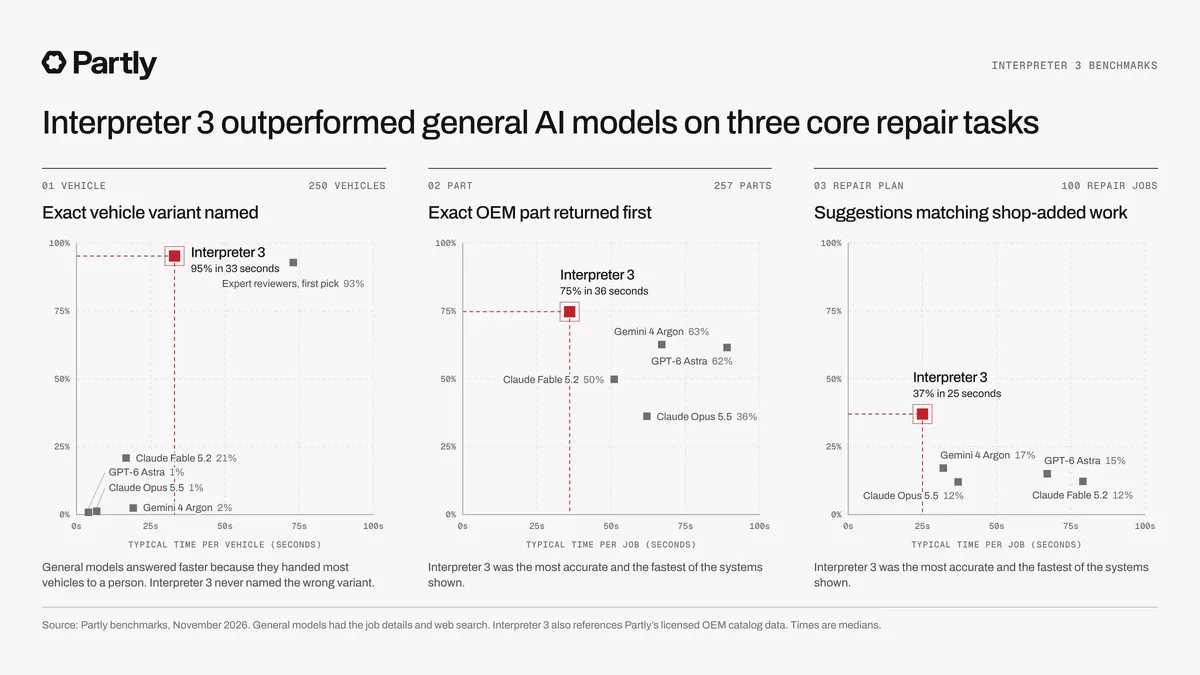
Partly reports the following results from its tests:
The right car: Interpreter 3 named the exact vehicle variant for 19 of every 20 cars, against 4 in every 20 for the best general model, and never named the wrong one. When it was not sure, it handed the job to a person. Expert reviewers got 18 of the 250 cars wrong on their first pick and took more than twice as long.
The exact part: Interpreter 3 returned the exact OEM part first for 75% of parts, ahead of Gemini 4 Argon (63%), GPT-6 Astra (62%) and Claude Fable 5.2 (50%). A typical job took 36 seconds, against 67 for Gemini 4 Argon, the next-most accurate model.
Repair planning: 37% of Interpreter 3's suggestions matched work the shop later added. That is more than twice the rate of Gemini 4 Argon (17%), GPT-6 Astra (15%) and Claude Fable 5.2 (12%), with fewer than half as many wrong suggestions for the estimator to dismiss. A typical job took 25 seconds, faster than any general model tested.
Partly adds that even expert estimators rarely agree on what a repair plan is missing.
How the tests were run
Partly completed the benchmarks in November 2026. It compared Interpreter 3 with six current-generation models with web search: GPT-6 Astra, Gemini 4 Hydrogen, Gemini 4 Argon, Gemini 4 Carbon, Claude Opus 5.5 and Claude Fable 5.2. The tests covered 250 vehicles, 257 parts and 100 repair jobs from a U.S. shop whose data was not used to train Interpreter. Interpreter 3 also references Partly's licensed OEM catalog data.
Why variant and part matching is hard
Partly says a single car model can be built in thousands of variants, the correct brake pads could be one of hundreds, and ADAS sensor calibration alone is written up in more than 25 ways. Given a VIN and the open web, the company says most general AI models could not name the exact variant, and more than a third of their part numbers were wrong.
The company says Interpreter has been trained over six years on millions of cars and billions of parts by a team that includes former estimators, mechanics and other repair professionals. Its repair knowledge covers vehicles going back more than 30 years, and it references licensed OEM data spanning more than 50 vehicle manufacturer brands.
“Every decision in repair depends on the exact car in front of you, which is what makes it so hard for general models,” said Levi Fawcett, co-founder and CEO of Partly. “Partly believes everything built should be repairable, and that repairers deserve AI built for the job. That belief drove how we trained Interpreter, with estimators on our team disassembling cars, labeling parts and feeding the model the real-world understanding this industry demands.”
Adding reasoning
Interpreter 3 builds on earlier versions by adding reasoning. Partly says it works through each repair problem, calls on specialized models and tools, and asks for clarification when a request does not add up. The estimator makes the final call.
Oscar Alanis, a former San Antonio estimator now at Partly, described what that means in the shop. “When I was estimating, I spent hours checking part numbers, digging through different systems and calling parts counters to make sure things fit,” Alanis said. “Interpreter takes that lookup off an estimator’s plate. You don’t second-guess your order, and if a part has changed, you know what to do next. That time goes back into building a better repair plan. That’s two or three more repair orders a week, and on $5,000 to $10,000 jobs, that adds up fast.”
Where it is available
Partly launched PartlyRepair AI, its agentic assistant for body shops, in the U.S. earlier this month and is in pilots with some of the largest U.S. multi-site operators. Interpreter already powers Partly's products in Europe and Australasia. Traction News covered the PartlyRepair AI launch at SEMA 2026.
Partly is headquartered in Austin, Texas, with more than 220 employees and additional offices in San Francisco, London, Christchurch and Auckland. In 2026 it raised a $50 million Series B led by DST Global at a $500 million valuation. Interpreter powers PartlyRepair AI for repair shops and PartlyLabs for repair networks, parts suppliers and enterprises. More at partly.com.