


In recent times, there has been a growing emphasis on greener, more fuel-efficient solutions in the automotive sector. Low rolling resistance tires are gaining traction as a practical and immediate way to reduce fuel consumption and emissions. By reducing the energy required to keep a vehicle in motion, these tires improve efficiency without altering vehicle architecture. From internal combustion engine vehicles to hybrid and electric models, low rolling resistance tires are increasingly becoming standard or recommended equipment. Let’s delve into what’s fueling the low rolling resistance tire market growth and how these tires are shaping the future of driving.
Low Rolling Resistance Tires: Introduction
Low rolling resistance tires are specially engineered tires designed to reduce the energy required to keep a vehicle moving. These tires minimize the friction between the tire and the road surface. This reduction in resistance leads to better fuel efficiency or extended battery range, based on whether it’s a gasoline-powered or electric vehicle. These tires reduce resistance owing to their construction, tread design, and rubber compound. Low rolling resistance tires make use of advanced materials that generate less heat as the tire flexes during rotation. The optimized tread patterns of these tires limit unnecessary deformation and allows for smoother rolling.
Major Market Highlights
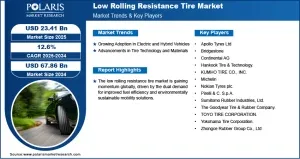
- The low rolling resistance tire market is poised to register robust growth, according to the latest market research report by Polaris Market Research.
- The market was valued at USD 20.85 billion in 2024 and is projected to reach USD 67.86 billion in 2034.
- The market is projected to exhibit a robust compound annual growth rate (CAGR) of 12.6% from 2025 to 2034.
- The report highlights that low rolling resistance tires are increasingly being used in passenger cars owing to the rising consumer focus on fuel economy and improved driving performance.
- The study notes that Asia Pacific is anticipated to witness significant demand for low rolling resistance tires due to rapid urbanization and rising vehicle ownership in the region.
Key Market Drivers
The market for low rolling resistance tires is witnessing rapid growth, driven by several factors. These include:
Environmental Regulations and Emissions Standards
Governments globally are introducing stringent environmental regulations. These policies are aimed at lowering greenhouse gas emissions and improving energy efficiency in the transportation sector. Initiatives such as the European Union’s tire labeling system rate tires on parameters like fuel efficiency, wet grip, and noise levels. This encourages consumers to choose more efficient products. Similarly, China’s new energy vehicle (NEV) regulations and other regional mandates require manufacturers to reduce rolling resistance as part of broader electrification and efficiency strategies. These policies create a favorable regulatory environment for the widespread adoption of low rolling resistance tires.
Rising Fuel Costs and Consumer Demand for Efficiency
The volatility of fuel prices has prompted individual consumers and businesses to look for technologies that reduce operating costs. Low rolling resistance tires reduce the amount of energy needed to keep the vehicle moving. This, in turn, direct translates to some percentage of fuel savings. The rising eco-consciousness among consumers has also led to many actively prioritizing fuel-efficient components as part of their purchasing decisions. Thus, economic benefits aligned with sustainability are fueling significant demand for low rolling resistance tires in retail and fleet sectors.
Technological Innovations in Low Rolling Resistance Tires
Here’s a look at some of the major technological innovations transforming the low rolling resistance tire market landscape:
Advanced Tread Compounds
One of the most critical innovation areas in low rolling resistance tires lies in the rubber formulation. Manufacturers are increasingly replacing or supplementing traditional carbon black compounds with silica-based fillers. These silica-based compounds reduce the amount of energy lost when the tire deforms, translating to lower rolling resistance while maintaining strong grip and durability.
View more Information at: https://www.polarismarketresearch.com/industry-analysis/low-rolling-resistance-tire-market/request-for-sample.
Optimized Tread Design
The tread pattern and architecture of a tire significantly influence its rolling resistance and overall performance. Low rolling resistance tire manufacturers are using precision-engineered tread designs to minimize tread block deformation, evenly distribute contact pressure, and maintain a consistent footprint. These optimized designs strike a delicate balance between low resistance and real-world performance needs.
Lightweight Construction
Another innovation transforming low rolling resistance tires is weight reduction. Tire mass directly influences the amount of energy needed to move the vehicle forward. Manufacturers are lowering weight through advanced internal structures such as low-mass sidewalls, reinforced beads, and lightweight steel or hybrid cords.
Smart Tire Technologies
The rising popularity of connected vehicles and intelligent mobility is driving the evolution of low rolling resistance tires to become smart components of the automotive ecosystem. Some tire models now feature automotive sensors that monitor crucial parameters like temperature, air pressure, tread depth, and wear patterns. The data is then fed into the vehicle’s control systems or mobile apps, enabling predictive maintenance and optimized driving.
To Conclude
The low rolling resistance tire market offers one of the most effective ways to improve vehicle efficiency, lower emissions, and support global climate goals. As innovation continues to improve performance, durability, and design, these tires are becoming an increasingly essential component in the transition to greener and smarter mobility.
Read more at: www.polarismarketresearch.com.