
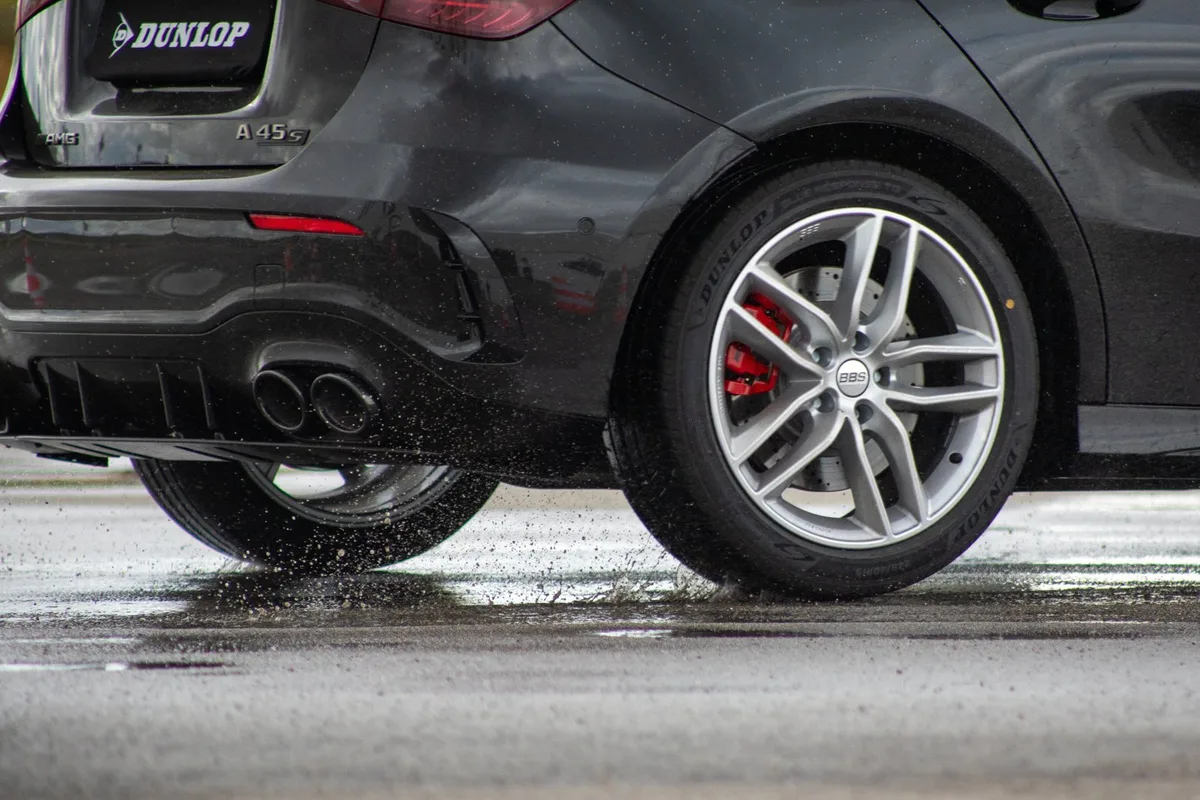
Dunlop Tyre Europe is using the UK's Tyre Safety Month, an annual UK road safety campaign run by the tyre safety charity TyreSafe, to encourage drivers to treat wet-weather driving as a skill worth practising. The European arm of Sumitomo Rubber Industries points to new TyreSafe research and Met Office climate data showing that rain-soaked roads are becoming a routine part of British winters.
Dunlop and sister brand Falken are partners of TyreSafe. The charity's latest research found that 83% of road users believe they are fully in control of their stopping distances, yet only 6% could correctly identify wet-weather stopping distances at motorway speeds. Some 94% underestimate how much stopping distances grow on wet roads.
Wetter winters in the UK
The Met Office's State of the UK Climate 2025 report, published in July, says UK winters are getting milder and wetter. Between 2016 and 2025, the winter half-year (1 October to 31 March) was 13% wetter than the 1961–1990 average and 3% wetter than the 1991–2020 baseline. Exceptionally wet winter months have roughly doubled in frequency over the past decade compared with the historic average.
Dunlop's wet-weather skills
Smoother inputs. With less grip available, steering, braking and acceleration should be smooth and progressive so the tyres can do their job without abrupt load changes.
Look further ahead. Drivers should extend their gaze down the road rather than just past the bonnet, so they can spot hazards, traffic, corners, gradients and surface changes earlier. Dunlop recommends building at least a four-second gap to the vehicle ahead in the wet, which also improves visibility. Planning ahead helps with gear selection on hills, keeping momentum and, over time, cutting brake and tyre wear.
Read the road surface. Beyond potholes, drivers should watch for shiny patches with reduced traction, drainage channels and worn wheel tracks where aquaplaning can occur, mud and fallen leaves, and painted road markings, which can be especially slippery when wet.
Match tyres to the conditions. Tyres are a car's only contact with the road, so maintenance and the right tyre choice are central to confidence and consistency through winter. Drivers should check for damage, sufficient tread depth and correct inflation pressures.
Watch tyre age, not just tread. Tyres age even when barely used, so the DOT date code should be checked regularly. Cars that sit for long periods or are exposed to weather and strong sun may need new tyres after about six years, and Dunlop advises replacing tyres after 10 years at the latest, regardless of tread depth.
The UK legal minimum tread depth is 1.6 mm, but TyreSafe urges drivers to plan replacements in good time, possibly with all-season tyres suited to the country's wet and unpredictable winters.
For drivers in the UK, perhaps the most overlooked driving skill today isn't the ability to drive quickly. Instead, it may well be learning how to drive confidently in the rain. It's important for any driver to remain safe when driving in the wet, and many drivers see rain as something that can limit their enjoyment behind the wheel. We would argue the opposite.
Driving is a skill people can spend their whole life mastering. And learning how to drive smoothly and safely in wet conditions can help make people better drivers all year round. With data showing UK winters becoming increasingly damp, wet-weather driving is a skill that car enthusiasts can – and should – actively develop.
— Thomas Deinhardt, Senior Technical and Service Engineer, Dunlop Tyre Europe
Driving in wet weather presents challenges for even the most experienced road users, and our research shows that many have a misplaced confidence in their ability to judge stopping distances in these conditions. As the UK experiences increasingly wet winters, understanding how to adapt our driving to the conditions has never been more important.
Developing good driving habits, such as leaving a greater stopping distance, anticipating hazards and accelerating and braking smoothly, can make a real difference to safety. Equally, ensuring tyres are properly maintained and have sufficient tread depth is essential to maintaining grip in wet conditions. Tyre Safety Month is an important opportunity to remind all road users that being prepared for wet weather starts with both their driving behaviour and their tyres.
— Stuart Lovatt, Chair, TyreSafe
About the partnership
Dunlop Tyre Europe joined TyreSafe earlier this year as a Charity Incorporated Organisation (CIO) member, the charity's highest membership level, covering both the Dunlop and Falken brands, and sits on its steering committee. Founded in 2006, TyreSafe works to reduce tyre-related incidents on British roads. Dunlop Tyre Europe, which operated as Falken Tyre Europe until February 2026, is based in Offenbach am Main, Germany, and distributes Dunlop, Falken and Sumitomo tyres across Europe. Parent Sumitomo Rubber Industries acquired the Dunlop four-wheel tyre brand rights for Europe, North America and Oceania in 2025.
Source: Dunlop Tyre Europe news release, issued via Elan PR. Climate data: Met Office, State of the UK Climate 2025.