
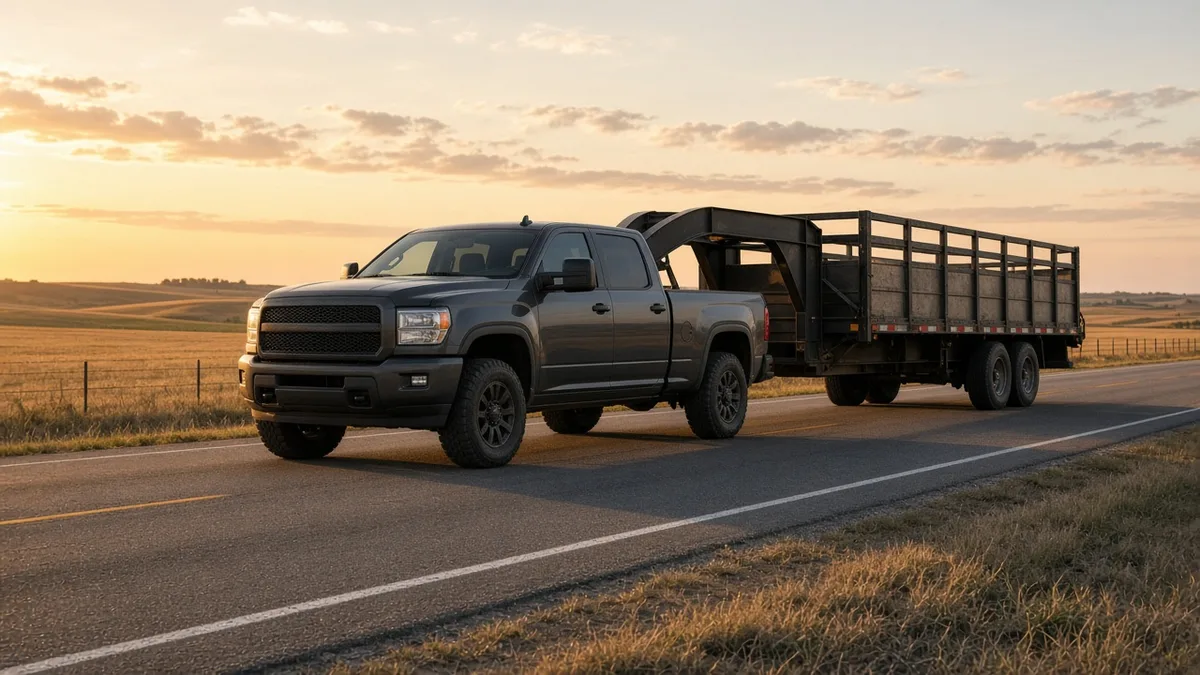
Plenty of pickup owners start with a bumper-pull trailer, a 16-foot utility or a small stock trailer, and eventually find themselves eyeing a gooseneck. The reasons are familiar: a heavier load, a longer deck, or a trailer that sways more than they would like on the highway. Switching is not just a trailer purchase. It changes what your truck carries, how it turns, and what goes in the bed. Here is what to look at on your own truck before you sign for anything.
1. Find out what the truck allows for in-bed towing
Owners' manuals and towing guides often list a separate rating for fifth-wheel and gooseneck towing, and it may differ from the conventional (receiver) rating. Look up the figure for your exact configuration: cab, bed length, engine, axle ratio, and drive type. A rating for a different axle ratio or cab style does not carry over.
If the published in-bed rating is lower than the trailer you have in mind, that answers the question before any hitch shopping begins.
2. Payload is usually the tighter limit
Tow rating gets the headlines, but on a gooseneck the number that runs out first is often payload. With a bumper pull, tongue weight hangs on the receiver behind the rear axle. With a gooseneck, a substantial share of the loaded trailer's weight presses straight down into the bed, and every pound of it counts against the truck's payload, along with passengers, fuel, a toolbox, and anything else riding along.
Look for the Tire and Loading Information placard on the driver's door pillar. Where it is present, federal standard FMVSS 110 has it state that "the combined weight of occupants and cargo should never exceed" a listed number. If your truck doesn't show that figure, work it out from the GVWR on the certification label minus what the truck weighs on a scale with a full tank and your normal gear.
Then do a real-world check before your first long trip. Load the trailer the way you'll use it and cross a certified truck scale. Weigh the truck alone, then the truck and trailer coupled, and compare against GVWR, rear axle rating, and GCWR.
3. Hitch installation: what's under the bed matters
There are two main approaches.
Factory prep or OEM-style puck systems. Many current heavy-duty pickups can be ordered with a gooseneck/fifth-wheel prep package that leaves mounting points in the bed. Adding a compatible ball insert is then a small job.
Aftermarket under-bed or rail-mounted kits. These bolt to the frame using brackets made for a specific truck. Installation usually means drilling the bed for the ball and the safety chain loops.
Before you book the install, check what lives under the bed. On some trucks, the spare tire, exhaust routing, or fuel tank sits near where the hitch brackets go and may need relocation. A drop-in bed liner typically needs cutting or replacement. A spray-in liner usually does not. You'll also need a 7-way connection that reaches the gooseneck. Many kits mount it near the bed or tailgate.
Ball placement matters as well. The ball normally sits slightly ahead of the rear axle centerline. Kits designed for your truck put it in the right spot, which is one reason to avoid improvised brackets.
4. Bed and cab clearance
Two clearances come into play once the trailer is on the ball.
Vertical clearance. The underside of the trailer's front overhang must stay above the truck's bed rails and tailgate when the rig crosses dips, driveway aprons, and pasture gates. Trucks and trailers vary in height, and most gooseneck couplers adjust. Set the coupler so the trailer rides close to level and still leaves the gap the trailer maker recommends.
Cab clearance in turns. In a sharp turn, the front of the trailer moves sideways over the bed and closes in on the back corner of the cab. Short beds leave less room than long beds. Before your first trip, hook up in an open lot, turn slowly to full lock in both directions, and have someone watch the gap. Note where contact would happen and avoid that steering angle in tight spots.
Remember the tailgate, too. Many owners tow with it down or remove it. Others use a tailgate designed for fifth-wheel and gooseneck use.
5. Turning radius and driving habits
Because the trailer pivots over the truck's rear axle rather than behind the bumper, a gooseneck generally tracks tighter in turns than a bumper pull of the same length. That helps in farm gates and feed-store lots. It also means the trailer cuts in closer to curbs, posts, and fuel islands than you may expect. Swing wider than you think you need for the first few weeks, and practice backing in an empty pasture or lot before trying it at a busy sale barn.
6. Match the trailer to the truck, not the other way around
Once you know your in-bed rating, real payload, and clearance limits, you can shop with numbers instead of guesses. To see how deck length, overall length, GVWR, and payload fit together on real trailers, this gooseneck sizing breakdown walks through the numbers. Compare its examples against what your truck can actually carry.
Quick pre-switch checklist
Confirm the in-bed towing rating for your exact truck configuration.
Calculate real payload and leave room for the trailer's pin weight.
Check what's under the bed before choosing a hitch kit.
Set coupler height for level towing and adequate rail clearance.
Test cab clearance at full lock in an open lot.
Weigh the loaded rig on a certified scale before the first long haul.
A gooseneck can be a big step up in stability and capacity. Done in this order, the switch has fewer surprises.
Sources
49 CFR 571.110 (FMVSS 110), Tire selection and rims, placard requirements: https://www.ecfr.gov/current/title-49/subtitle-B/chapter-V/part-571/subpart-B/section-571.110