

According to Research Intelo, the Global Bluetooth Tire Pressure Sensors market size was valued at $2.4 billion in 2024 and is projected to reach $7.1 billion by 2033, expanding at a CAGR of 12.7% during the forecast period of 2025–2033. The primary growth driver for this market is the increasing emphasis on vehicle safety and regulatory mandates that require the integration of tire pressure monitoring systems (TPMS) in both passenger and commercial vehicles worldwide. The growing demand for real-time tire pressure data, seamless connectivity, and enhanced driving experience is propelling the adoption of Bluetooth-enabled TPMS, especially as automotive manufacturers increasingly prioritize advanced driver-assistance systems (ADAS) and smart vehicle technologies. Additionally, the proliferation of connected vehicles and rising consumer awareness regarding fuel efficiency and tire longevity further bolster the market’s expansion trajectory.
The automotive industry is undergoing rapid digital transformation, and one of the most important safety innovations to emerge in recent years is the bluetooth tire pressure sensor. These compact devices allow drivers to monitor tire pressure in real time directly through their smartphones or vehicle infotainment systems. As road safety awareness increases and smart vehicle technologies become more widespread, the Bluetooth tire pressure sensors market is gaining strong traction across passenger and commercial vehicle segments.
Technology Overview
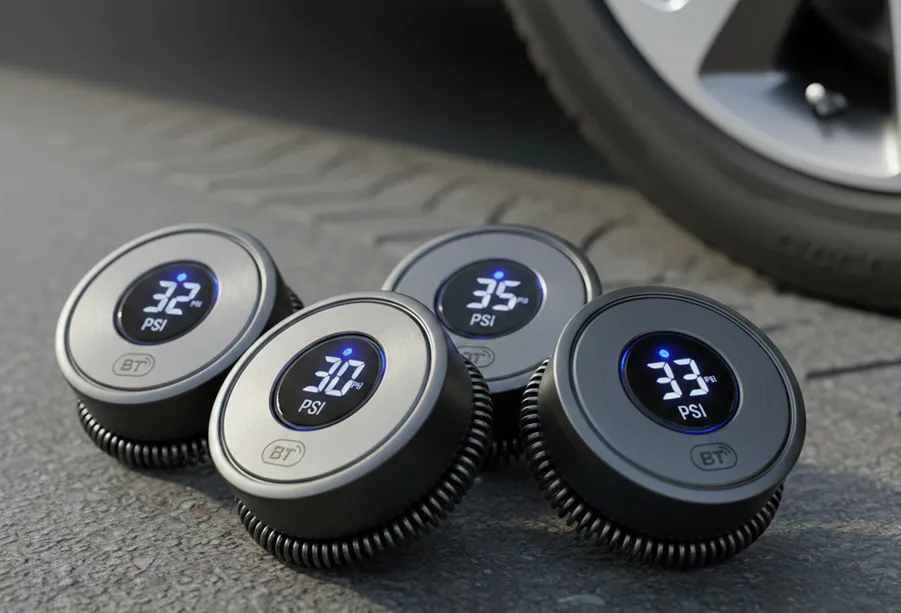
Bluetooth tire pressure sensors are typically installed inside the tire, attached to the valve stem or embedded in the wheel assembly. These sensors continuously measure air pressure and often temperature as well. The collected data is transmitted via Bluetooth Low Energy (BLE) protocol to a paired smartphone or microcontroller system.
The real-time nature of these sensors enables instant alerts when tire pressure falls outside recommended levels. Advanced models also provide predictive maintenance warnings, historical trend analysis, and integration with fleet management software. This level of intelligence turns tires from passive mechanical components into active data-generating assets within the broader vehicle ecosystem.
Market Drivers: Key Forces Accelerating Adoption
Several strong drivers are fueling growth in the Bluetooth tire pressure sensors market. First, government regulations regarding vehicle safety are becoming stricter worldwide, pushing manufacturers to integrate tire monitoring technologies as standard or optional features. Second, rising fuel costs and environmental concerns are encouraging drivers and fleet operators to maintain optimal tire pressure to improve fuel efficiency and reduce carbon emissions.
The increasing popularity of electric vehicles (EVs) is another significant factor. EVs are heavier than conventional vehicles due to battery packs, making tire health monitoring even more critical. Bluetooth-based solutions offer a cost-effective and scalable way to meet these evolving requirements.
In addition, the rise of connected vehicles and the Internet of Things (IoT) ecosystem is expanding the role of Bluetooth-enabled automotive sensors. Consumers now expect seamless smartphone integration for vehicle-related data, and tire pressure information is becoming a standard part of this connected experience.
Challenges and Constraints
Despite its strong growth potential, the Bluetooth tire pressure sensors market faces several challenges. Signal interference and connectivity issues can sometimes affect real-time data accuracy, especially in high-frequency electromagnetic environments. Compatibility concerns between different smartphone operating systems and vehicle platforms can also limit seamless user experience.
Battery lifespan is another critical challenge. Since most of these sensors are battery-powered, frequent replacements can increase maintenance costs and reduce user convenience. To address this, manufacturers are investing in energy-efficient chipsets and energy-harvesting technologies.
Data security and privacy concerns are also gaining attention. As these sensors transmit wireless data, manufacturers must ensure strong encryption and secure communication protocols to protect user information from cyber threats.
Future Outlook: Smart Tires as a Core Part of Vehicle Intelligence
The future of the Bluetooth tire pressure sensors market looks promising, with strong opportunities driven by vehicle digitalization and smart mobility trends. As autonomous and semi-autonomous vehicles become more common, real-time tire health data will become a critical input for vehicle control systems.
Integration with cloud-based vehicle health platforms and smart city infrastructure is expected to expand further. In the coming years, these sensors may also evolve to monitor additional parameters such as tread depth, road surface conditions, and tire wear patterns, transforming tires into advanced diagnostic tools.
In the long term, Bluetooth tire pressure sensors are likely to become standard features not only in premium vehicles but also in mid-range and budget segments, driven by falling component costs and mass adoption of connected technologies.
Competitive Landscape
Prominent companies operating in the market are:
- Schrader Electronics
- Continental AG
- Sensata Technologies
- Pacific Industrial Co., Ltd.
- Denso Corporation
- Huf Hülsbeck & Fürst GmbH & Co. KG
- ATEQ TPMS Tools
- NXP Semiconductors
- Infineon Technologies AG
- ZF Friedrichshafen AG
- Bendix Commercial Vehicle Systems
- Steelmate Co., Ltd.


