
Voice and chat agents built for the tire industry are turning missed calls into booked bays. Here is what is driving the shift, and what dealers should look for before they buy.
The busiest hour at a tire shop is also the hour the phone stops getting answered. The techs are in the bays, the counter is three deep, and somewhere between mounting a set of tires and running a card, a call rings out. Industry data suggests it happens far more often than most owners realize. Call analytics firm Marchex found that up to 21 percent of automotive service calls go unanswered, and the Automotive Service Association has put the figure at nearly one in four calls during regular business hours.
Every one of those calls is a customer who has already decided to spend money. Most will not leave a voicemail. They will simply call the next shop on the list.
That math, combined with a labor market that shows no sign of loosening, explains why AI voice and chat agents have become one of the fastest-moving categories in automotive retail. The TechForce Foundation projects a shortfall of more than 20,000 automotive technicians per year, and counter staff are no easier to find. Every minute a service advisor spends triaging the phone is a minute not spent closing the customer standing in front of them.
Why generic AI receptionists stall out in a tire store
The first wave of AI phone tools were generic receptionists, trained to take messages and read business hours aloud. The tire business exposes them quickly. Fitment, staggered sizes, load ratings, speed ratings, rebates and out-the-door pricing are not things a general-purpose assistant can improvise. A caller who says he needs four tires for a 2021 F-150, stock size, expects whoever answers to know that means 275/65R18, what is on the shelf in that size, and what it costs out the door with mount and balance.
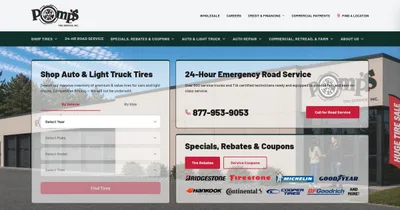
That gap is where tire-specific platforms are emerging, and Tireweb AI is among the most complete examples. Built by Tireweb, the company behind websites and e-commerce for tire dealers, the platform runs a voice agent and a website chat agent on the same brain. Both are backed by Tirelibrary, a database of more than 240,000 tire SKUs across 440 brands with normalized specs, imagery, rebates and MAP pricing, the product of more than 20 years in the tire data business.
In practice, the agent picks up the phone in under two seconds, looks up the caller's vehicle, quotes good, better and best options from the dealer's live inventory with real out-the-door totals, and books the job directly onto the shop's actual bay calendar, confirming by SMS.
“Dealers don't lose sales because they don't know tires. They lose them because the phone rang at the wrong time,” said Matthew Walker, Chief Executive Officer of Tireweb. “An AI agent doesn't take lunch and doesn't go home at six. But it can only sell tires if it actually knows tires. Fitment, sizing, rebates, what's on the shelf. That's the difference between an answering service and a salesperson.”
Knowing when to hand off
The more mature systems are also learning when to step aside. Tireweb AI flags complex calls or complaints and can take message or pass them to a human with the full conversation attached. Dealers can run the agent around the clock or only after hours, and multi-store operations can route each call, chat or booking to the right location.
“The goal isn't to replace the counter. It's to make sure the counter never loses a customer it never got to talk to,” Walker said. “When a fleet call or a warranty issue comes in, the AI can hand the phone to your team or take a message. The easy quote-and-book calls it just handles.”
What dealers should look for
Not every AI agent is built the same, and the differences show up in lost sales rather than in the demo. Before signing on, dealers should ask whether a platform can prove the following:
- Tire-specific training: fitment, sizing conventions, brand families and service workflows, not generic small-talk.
- Live inventory and pricing: quotes should come from your actual stock and include real out-the-door totals.
- Real calendar booking: appointments should land on your shop schedule automatically, not in an email inbox.
- Sentiment tracking: Identifying complaints or calls requiring escalation.
- Transcripts and analytics: every conversation should be reviewable, scored and exportable.
The phone is not going anywhere. It remains the highest-intent channel in tire retail, and it is also the one most shops are structurally unable to cover. AI agents that genuinely know the product have turned that from an accepted cost of doing business into a solvable problem. The dealers who win the next few years will not necessarily be the ones with the biggest ad budgets. They will be the ones whose phone always gets answered.
Read more about Tireweb AI at www.tireweb.com.