

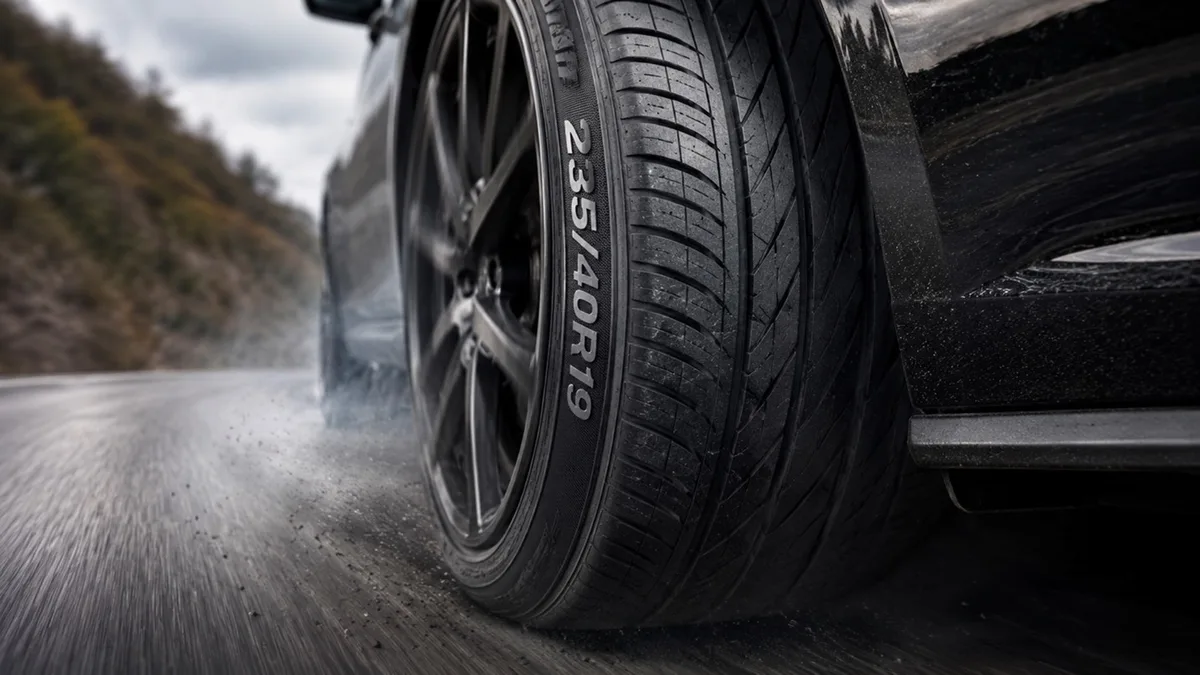
The 235/40r19 is a low-profile, 19-inch fitment used as original equipment on performance sedans, compact sport SUVs, and luxury coupes from European manufacturers. The 235mm section width, 40-series sidewall, and 19-inch rim requirement are fixed. What varies is the tire category, compound, and speed rating and those choices determine how well the tire actually performs on your vehicle and in your conditions. This guide covers the size in full: decoded specifications, confirmed OEM vehicle list, rim requirements, available tire categories, and a framework for picking the right option.
Decoding the 235/40R19 Size Marking
Tire size codes are standardized across manufacturers. Every segment of 235/40R19 carries a fixed technical meaning that affects fitment, performance, and compatibility.
Two numbers define the character of this tire. The first is 235, the section width in millimeters, measured at the tire's widest point sidewall to sidewall. At 235mm, this is a wide contact patch by passenger car standards, contributing to the lateral stability and traction the size is known for.
The second is 40, the aspect ratio, expressing sidewall height as a percentage of section width. Forty percent of 235mm produces a sidewall of 94mm, roughly 3.7 inches. That is a short sidewall. Short sidewalls sharpen steering response and reduce body roll under cornering load because there is less flex in the rubber column between rim and road. The trade-off is a firmer ride and greater sensitivity to road surface irregularities. Drivers who swap to a higher-profile tire in the same width sometimes describe the 40-series as punishing on poor roads. That is the physics working as intended.
The 19-inch rim diameter is not a variable. This tire fits a 19-inch wheel only. The recommended rim width range of 8.0 to 9.5 inches is where fitment flexibility exists, and the choice within that range affects handling behavior in measurable ways.
Confirmed OEM Fitment by Vehicle
The following vehicles are confirmed to use 235/40R19 as original equipment, sourced from the Wheel-Size.com global fitment database, last updated May 14, 2026. Always verify against your owner's manual and door placard before purchasing. Variant-level differences within a model range can affect the correct size.
- RS4: 2005 to 2008 and 2012 to 2025
- RS5: 2017 to 2025
- SQ2: 2019 to 2026
- Q2: 2016 to 2026
- 1 Series (F70): 2024 to 2026
- 2 Series Gran Coupe: 2025 to 2026
- 159, Brera, and Spider: 2005 to 2011
- DB9: 2004 to 2012
- V8 Vantage: 2005 to 2017
- V12 Vantage: 2008 to 2018
- Cupra Ateca: 2023 to 2025
- Ford Fusion: 2013 to 2021
- Chrysler 200: 2015 to 2017
- Cadillac CTS and STS: various model years
The pattern across this list is consistent: the 235/40R19 is predominantly found on sport-oriented and performance vehicles, which informs the tire category that suits it best.
Rim Width and Its Effect on Performance
Within the 8.0 to 9.5-inch recommended rim width range, the choice is not arbitrary. Rim width changes the shape of the mounted tire and, with it, the behavior of the contact patch.
- 0 to 8.5 inches:
- 0 to 8.5 inches: The tire mounts in a slightly more rounded profile. The contact patch narrows marginally and the sidewall sits more upright. Tread wear is even across the width in normal driving but inner and outer shoulder wear can accelerate under sustained hard cornering.
- 0 to 9.5 inches: The tire is stretched slightly across a wider rim face. The contact patch widens and flattens, improving the tire's ability to resist lateral deformation under cornering load. This setup is preferred for performance driving and track use.
- Outside the recommended range: Mounting below 8.0 or above 9.5 inches takes the tire outside its design envelope. Sidewall stress, contact patch geometry, and handling predictability are all affected negatively. Do not exceed the manufacturer's stated range.
Offset and backspacing are separate considerations that depend on your specific vehicle's suspension geometry and hub clearance. Confirm both before finalizing a wheel and tire combination.
Tire Categories Available in 235/40R19
Summer and Ultra High Performance
Summer and ultra-high performance tires are the natural category for this size. The vehicles this tire fits were engineered around maximum dry and wet road grip, and summer tires are built to deliver exactly that. Their compounds are tuned to work between approximately 7 degrees Celsius and the upper range of road surface temperatures, maintaining grip and responsiveness across a wide performance window in those conditions.
Speed ratings in this category run from V (240 km/h) through W (270 km/h) to Y (300 km/h). Never install a tire with a speed rating below the OEM specification for your vehicle. Load index for 235/40R19 summer tires is typically 92 (1,389 lbs. per tire) or 96 in Extra Load (XL) variants (1,565 lbs per tire). Check your door placard for the minimum load index required.
What summer tires give up is winter usability. Below 7 degrees Celsius the compound stiffens, grip drops, and braking distances extend. In markets where winter temperatures are routine, running a summer tire year-round is a safety issue, not just a performance one.
All-Season
All-season tires in 235/40R19 offer year-round usability and are a practical choice for drivers in temperate climates where the weather is variable but severe winters are not the norm. Models carrying the three-peak mountain snowflake (3PMSF) symbol have been certified to meet minimum traction performance in severe snow conditions, which extends their usability further.
The trade-off relative to a summer tire is measurable and documented. Tire Rack's comparative testing consistently shows all-season tires losing lateral grip and wet braking performance against equivalent-tier summer tires in warm conditions. For a daily driver used in mixed conditions, that trade-off is typically acceptable. For a driver who uses the vehicle at its performance limits on track or on mountain roads, it is not.
All-season tires also do not replace a dedicated winter tire in genuine winter conditions. The 3PMSF rating certifies snow traction performance, not ice traction. On ice, a dedicated winter tire outperforms all-season at all temperatures.
Winter
Dedicated winter tires in 235/40R19 are available in a more limited selection than all-season or summer, but they exist. In markets with sustained sub-zero temperatures, persistent ice, or heavy snowfall, a dedicated winter tire is the correct technical answer. Mounted on a separate set of 19-inch wheels, a winter set allows the summer or all-season tires to be stored off-season, protecting both sets and extending their total service life.
The performance difference between a dedicated winter tire and an all-season tire in genuine winter conditions is not marginal. Stopping distance on ice at minus 10 degrees Celsius can differ by 30 to 40 percent between the two categories in published testing. That is not a gap worth closing with confidence in the all-season label.
Choosing the Right Tire for Your Use Case
The correct tire in 235/40R19 is determined by three factors: the climate you drive in, how you drive, and what the vehicle's OEM specification requires as a minimum on load index and speed rating. Use this framework:
- Warm or temperate climate, primarily dry and wet roads, spirited road driving: Summer or UHP tire. This is the category the size and the vehicles it fits were designed around.
- Four-season temperate market, daily driving, no sustained winter conditions: All-season with 3PMSF rating. Prioritise a model with documented wet braking performance rather than choosing on tread life alone.
- Winter climate, sub-zero temperatures, ice, or snow: Dedicated winter tire on a separate wheel set. Do not attempt to manage genuine winter conditions on a summer tire.
- Track use or high-performance road driving: UHP summer tire, confirm speed rating meets or exceeds OEM specification. For track days specifically, consult the circuit's tire regulations before purchasing.
Alternative Sizes and When to Consider Them
If the specific tire model you want is not available in 235/40R19, an alternative size may be acceptable if the overall diameter stays within 3% of the original. Exceeding that tolerance affects speedometer accuracy and, in some vehicles, triggers ABS and stability control calibration errors.
- 225/40R19: 10mm narrower. Slightly smaller contact patch. Overall diameter within acceptable tolerance on most calculators. The narrower width reduces lateral grip marginally.
- 245/40R19: 10mm wider. Larger contact patch, marginally higher rolling resistance. Confirm the wider tire clears suspension components and wheel arch on your specific vehicle.
- 235/45R19: Taller sidewall, more ride compliance. Overall diameter is larger and may fall outside the 3% window, verify with a tire size calculator before fitting. The taller sidewall changes the handling character noticeably.
Confirm any alternative size against a tire size calculator. The 3% diameter rule applies in both directions and is not a guideline, exceeding it creates measurable instrumentation and safety system errors in modern vehicles.
Frequently Asked Questions
Does my vehicle definitely take a 235/40R19?
Check the tire placard on the driver's door jamb and your owner's manual. Both list the OEM-approved size along with the required load index and speed rating. The fitment list in this guide is sourced from the Wheel-Size.com database (May 2026) and covers confirmed OEM fitments, but model variants within the same nameplate can carry different standard sizes. The placard on your specific vehicle is the authoritative source.
What load index do I need?
Match or exceed the load index shown on your door placard. For most vehicles running 235/40R19 as OEM, the load index is 92 (1,389 lbs per tire) or 96 in XL variants (1,565 lbs per tire). Installing a tire with a lower load index than specified reduces the tire's rated load capacity below the vehicle manufacturer's requirement. That is a safety compromise and can affect insurance coverage in the event of an incident.
Can a 235/40R19 tire go on any 19-inch wheel?
Not quite. The rim diameter of 19 inches is mandatory, but rim width must fall within the 8.0 to 9.5-inch recommended range for the tire to mount and perform correctly. Width outside that range affects the contact patch geometry, wear distribution, and handling predictability. Beyond width, confirm that the wheel's offset and backspacing suit your vehicle's hub dimensions before purchasing.
What is the difference between a V and W speed rating at this size?
A V speed rating certifies the tire to sustained speeds up to 240 km/h. A W rating certifies up to 270 km/h. For the vehicles that commonly use 235/40R19 as OEM, the minimum rating is typically V or W depending on the variant. Never install a tire rated below the OEM minimum. A Y rating (up to 300 km/h) is available in some UHP models in this size and is appropriate for the highest-performance variants of the vehicles on this fitment list.
Is 235/40R19 suitable for winter use?
A summer or UHP tire in this size is not suitable for winter use below approximately 7 degrees Celsius. Compound stiffening at low temperatures significantly reduces grip and extends braking distance. In markets with genuine winter conditions, fit a dedicated winter tire on a separate 19-inch wheel set. All-season tires with 3PMSF rating are a compromise that works in mild winter markets but not in sustained sub-zero, high-snow, or ice-dominant climates.
Summary
The 235/40R19 is a well-defined performance fitment. Section width of 235mm, 40-series sidewall, 19-inch rim, with a recommended rim width of 8.0 to 9.5 inches. It is primarily an OEM size on European sport and luxury vehicles, which points clearly toward summer or UHP performance tires as the first-choice category for most drivers who use it.
The decision tree is straightforward: warm or mixed climate means summer or all-season, genuine winter climate means a dedicated winter set, and performance or track use means a UHP summer tire with a speed rating that meets or exceeds the OEM specification. Do not downgrade load index or speed rating below what the door placard specifies.


